Imagine a customer in the US or Europe opening a Web3 application for the first time.
Instead of asking them to install a wallet, save a seed phrase, buy ETH for gas, and understand blockchain networks, the application simply asks:
What would you like to do?
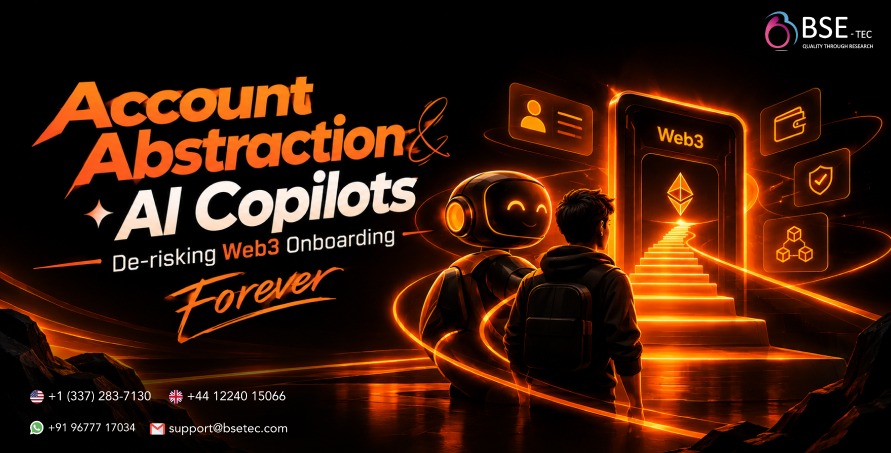
That is the experience businesses are moving toward with Account Abstraction and AI Copilots.
At BSEtec, this shift connects two important areas of Web3 development: programmable Smart Accounts and AI-powered user experiences. The goal is simple — remove unnecessary blockchain complexity while keeping transactions secure, controlled, and easy to understand.
And this is becoming more than a Web3 idea. Ethereum’s current Account Abstraction roadmap reports more than 26 million smart wallets and 170 million UserOperations, showing that smart-account infrastructure has moved well beyond the experimental stage.
Why Web3 Onboarding Still Has Friction
Traditional Web3 onboarding can feel complicated for new users.
First, they need a wallet. Then, they may need a seed phrase, native tokens for gas, network selection, and several transaction approvals.
For crypto-native users, this process may be familiar.
However, for a customer using a financial platform, gaming application, or enterprise service, these steps can become a barrier.
Therefore, the challenge is no longer only about blockchain scalability.
It is about making blockchain simple enough for mainstream users.
What Is Account Abstraction?
Account Abstraction makes blockchain accounts programmable.
Instead of relying on a basic wallet controlled only by a private key, businesses can create Smart Accounts with custom rules.
For example, a Smart Account can support:
- Gasless transactions
- Spending limits
- Transaction batching
- Recovery options
- Custom permissions
- Flexible authentication
ERC-4337 enables this model through UserOperations, bundlers, and the EntryPoint system. Ethereum also highlights gas sponsorship, recovery, and improved user experience as key benefits.
BSEtec has already covered this shift through its work on Smart Accounts and Account Abstraction.
Where AI Copilots Change the Experience
Account Abstraction can simplify the wallet.
An AI Copilot can simplify the interaction.
Instead of asking users to understand blockchain terminology, the Copilot can explain what is happening in simple language.
For example, a customer could say:
“Send $100 USDC to this supplier.”
The AI Copilot can then explain the transaction, check the relevant details, and prepare it for approval.
Behind the scenes:
AI Copilot → Understands the request
Smart Account → Manages permissions
Paymaster → Handles gas
Smart Contract → Executes the action
Blockchain → Records the transaction
As a result, customers focus on the business action rather than blockchain mechanics.
Gasless Transactions Remove Another Barrier
Gas is one of the biggest problems for new Web3 users.
A customer may already have USDC but still need ETH to complete a transaction.
That creates unnecessary friction.
With Account Abstraction, Paymasters can sponsor transaction fees. As a result, users can interact with an application without first buying the network’s native token. ERC-4337 specifically supports sponsored transactions and flexible gas-payment models.
BSEtec’s Gasless UX approach removes this native-token barrier through Account Abstraction and Paymaster infrastructure.
Explore BSEtec’s Gasless UX approach
This creates a much simpler journey:
Sign up → Smart Account → Approve → Transaction complete
No separate gas purchase is required.
AI Copilots Can Also Reduce Mistakes
Simplifying Web3 is not only about convenience.
It is also about helping users understand risky actions before they approve them.
For instance, instead of showing a technical contract permission, an AI Copilot could explain:
“This application is requesting permission to use your USDC. Review the amount before approving.”
That explanation gives users more context.
However, the Copilot should not have unlimited control over financial actions.
Instead, AI should assist while users and predefined account rules remain in control.
This becomes especially important for financial applications and enterprise customers.
The Bigger Trend: AI Agents Are Starting to Make Payments
The combination becomes even more interesting when AI moves from assisting users to performing specific tasks.
In September 2026, Reuters reported that India was preparing an agentic payments framework for UPI, including rule-based payments, spending limits, identity checks, and delegated payment authority for AI agents. Similar agentic-payment initiatives are also developing internationally.
This trend matters for Web3 too.
An AI agent could eventually:
- Purchase a digital service
- Pay for computing resources
- Access a licensed dataset
- Interact with a smart contract
- Manage a predefined budget
Account Abstraction can provide the programmable account layer needed for these activities.
For example, an AI agent could have a daily spending limit and approved payment destinations. If a transaction falls outside those rules, the Smart Account can reject it.
BSEtec’s work around autonomous AI agents and smart contracts is aligned with this broader movement toward programmable, machine-driven blockchain transactions.
A Practical Enterprise Example
Consider a European B2B marketplace using blockchain for supplier payments.
A new customer joins the platform.
Instead of installing a wallet and buying ETH, the platform creates a Smart Account. Then, an AI Copilot explains each payment in simple terms.
The customer approves a $500 payment.
Behind the scenes, the Paymaster handles the gas, the Smart Account checks the user’s permissions, and the smart contract completes the transaction.
For the customer, it feels like a normal business payment.
For the enterprise, however, the blockchain still provides programmable rules, transaction records, and automated execution.
That is the real value of invisible Web3 infrastructure.
Why This Matters for Global Businesses
For businesses targeting customers across the US, Europe, UK, Middle East, and other international markets, reducing onboarding friction can be especially important.
Customers do not want to learn blockchain before using a product.
Instead, they expect familiar experiences such as simple login, clear instructions, predictable costs, and quick transactions.
Therefore, Account Abstraction can handle the blockchain complexity while an AI Copilot handles the communication layer.
Together, they can create a Web2-like experience powered by Web3 infrastructure.
How BSEtec Helps Build AI-Powered Web3 Experiences
BSEtec combines AI development and blockchain engineering to help businesses build simpler Web3 applications.
The technology can include:
- Account Abstraction Development – Build programmable Smart Accounts with custom transaction rules.
- AI Copilot Development – Create AI interfaces that explain and guide Web3 actions.
- Gasless UX – Integrate Paymasters and sponsored transactions.
- Smart Wallet Development – Add permissions, recovery, spending limits, and flexible authentication.
- AI Agent Integration – Connect autonomous agents with blockchain transactions and smart contracts.
- Web3 Application Development – Build complete blockchain applications with user-friendly interfaces.
BSEtec’s existing blockchain work covers Account Abstraction, Smart Accounts, gasless transactions, smart contracts, AI agents, and Web3 infrastructure.
Explore BSEtec’s Blockchain Development Solutions
Final Thoughts
Account Abstraction and AI Copilots can change how global customers experience Web3.
Instead of learning wallets, gas fees, networks, and complex transaction steps, users can simply explain what they want to accomplish.
Meanwhile, Smart Accounts manage permissions, Paymasters handle gas, and smart contracts execute predefined rules.
That makes blockchain technology much easier to use without removing the underlying security and control.
For businesses in the US, Europe, UK, and global markets, this can create a smoother path toward Web3 adoption.
This is where BSEtec brings strong AI and blockchain development expertise together. From Account Abstraction and Smart Wallets to AI Copilots, gasless transactions, smart contracts, and autonomous AI agents, BSEtec helps businesses turn complex Web3 infrastructure into simple digital experiences.
Explore BSEtec’s Account Abstraction and Web3 capabilities
The next generation of Web3 may not ask users to understand blockchain.
It may simply understand what users want — and let the blockchain handle the rest.