Smart contracts have always been one of the most powerful innovations in blockchain technology. They allow digital agreements to execute automatically without intermediaries, enabling trustless systems for finance, governance, gaming, supply chains, and more. However, despite their power, smart contracts are extremely sensitive pieces of software. Even a small coding mistake can lead to irreversible financial losses once deployed on a blockchain.
In 2026, Artificial intelligence is transforming how these contracts are designed, written, tested, and deployed. Developers can now use AI coding assistants to generate Solidity code, explain contract logic, detect vulnerabilities, optimize gas usage, and even suggest security improvements. This shift is making blockchain development faster, more accessible, and more scalable than ever before.
But this transformation also raises a critical question:
If AI can generate smart contracts in seconds, can we trust it to secure systems that manage real-world money and digital assets?
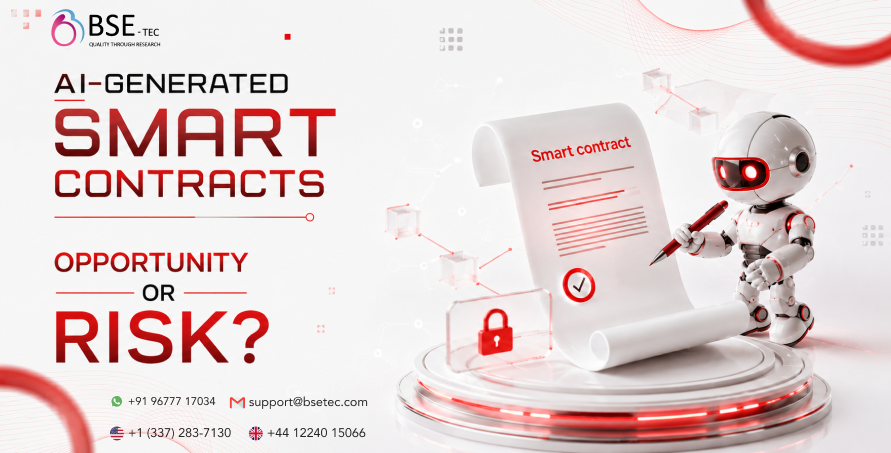
The answer is not simple. AI-generated smart contracts represent both a major opportunity and a serious risk. The outcome depends on how responsibly AI is used, how well humans supervise it, and how strong the development and security processes are.
The Rise of AI-Generated Smart Contracts in 2026
AI-assisted development has evolved far beyond basic autocomplete tools. Modern AI systems can now understand natural language instructions and convert them into functional smart contracts. Developers can describe requirements such as “create a staking contract with reward distribution and withdrawal limits,” and AI can generate a working Solidity implementation within seconds.
Advanced reasoning models can also:
- Explain contract logic in simple language
- Generate unit and integration tests
- Identify potential vulnerabilities
- Suggest gas optimizations
- Refactor inefficient code
- Simulate attack scenarios
Research in 2026 shows that while AI-generated contracts often appear syntactically correct and functionally complete, they may still contain hidden security flaws. This creates a dangerous illusion of correctness.
A contract that compiles successfully is not necessarily secure.
A contract that passes basic tests is not necessarily safe for production.
In blockchain systems, this distinction is critical because deployed contracts are often immutable or extremely difficult to modify.
Why Developers Are Adopting AI for Smart Contracts
Despite the risks, AI adoption in blockchain development is growing rapidly. The reason is simple: smart contract development is complex, repetitive, and time-consuming.
AI helps developers in several key areas.
Faster Code Generation
Instead of writing boilerplate code from scratch, developers can generate initial contract structures instantly. For example, AI can create ERC-20 tokens with features like Role-based access control, Minting and burning functions, pausability mechanisms, and Supply caps
This allows developers to focus more on architecture and security rather than repetitive coding tasks.
Rapid Prototyping
Startups and enterprises use AI to validate blockchain ideas quickly. AI can generate prototypes for DeFi lending platforms, NFT marketplaces, DAO governance systems, Blockchain-based games, tokenized asset systems, and Staking and reward platforms. This significantly reduces time-to-market, allowing faster experimentation. However, prototypes must never be mistaken for production-ready systems.
Automated Testing Support
AI can generate test cases that simulate real-world conditions such as Unauthorized access attempts, Token transfer failures, Reentrancy attacks, Edge-case input handling, and Contract state manipulation
This improves testing coverage and helps developers identify issues earlier in the development cycle.
Improved Documentation
Smart contracts often become difficult to understand over time. AI can generate clear documentation, explain functions, and summarize contract behavior, making collaboration easier across development teams.
AI as a Blockchain Development Copilot
The most realistic model in 2026 is not AI replacing developers, but AI acting as a development copilot.
In this model:
- Developers define architecture and business logic
- AI assists with code generation and testing
- Humans validate security and correctness
- Final responsibility remains with engineers
This hybrid approach significantly improves productivity while maintaining control over critical decisions.
For companies working with a blockchain development company, this model is especially valuable. It allows faster delivery without compromising security standards.
At BSEtec, AI is integrated as an accelerator within the blockchain development lifecycle. However, it is never treated as a replacement for experienced blockchain engineers. Instead, it supports developers in building more efficient, secure, and scalable solutions.
This distinction is important because smart contract development is not just about writing code. It is about understanding Economic incentives, Attack vectors, User behavior, Protocol interactions, and System-level risks. AI cannot fully replace this level of reasoning.
Where the Risks Begin
1. Vulnerable Code: AI-generated contracts can contain reentrancy, access-control, oracle, flash-loan, and logic vulnerabilities. Human security audits are still essential.
2. Business Logic Errors: AI may misunderstand financial rules such as collateral ratios or reward calculations, creating serious economic risks.
3. Overconfidence: AI can confidently mark code as secure even when hidden vulnerabilities remain. Testing alone cannot guarantee complete security.
4. New Attack Surface: AI coding agents can introduce risks through malicious prompts, poisoned dependencies, compromised tools, or unauthorized code changes.
Real-World Security Impact in 2026: The first half of 2026 saw nearly $940 million lost across 135 DeFi attacks. This proves that audits reduce risk, but continuous security is essential.
AI as a Security Tool: AI can detect vulnerabilities, analyze code, simulate attacks, identify dependency risks, and suggest patches. So, it can support both attack simulation and defense.
A Safe AI Smart Contract Workflow: A safer process is: define requirements → generate code → human review → test → security analysis → audit → testnet → monitor → deploy.
The Changing Role of Developers: AI is not replacing developers. Instead, developers are focusing more on architecture, security, threat analysis, economic design, and governance.
Opportunity vs Risk: AI enables faster development, testing, and prototyping. However, vulnerabilities, logic errors, overreliance, and new attack surfaces remain. The outcome depends on how responsibly AI is used.
What Businesses Should Do in 2026
Businesses should review AI-generated code, limit AI permissions, maintain secure dependencies, conduct regular audits, and document AI usage. Partnering with an experienced blockchain development company can further improve security and scalability.
BSEtec’s Role in AI-Driven Blockchain Development
In this evolving landscape, BSEtec plays a key role in bridging AI innovation with secure blockchain engineering.
As a trusted Blockchain development company, BSEtec integrates AI-assisted development into its blockchain solutions while maintaining a strong emphasis on Smart contract security, Code auditing practices, Protocol-level design, Real-world deployment safety, and Scalable architecture development
Rather than relying solely on AI, BSEtec combines human expertise with AI acceleration to deliver production-ready blockchain systems. This approach ensures that clients benefit from faster development cycles without compromising on security or reliability.
The Future of AI and Smart Contracts
The future will likely move beyond simple code generation. AI will increasingly assist in:
- Tokenomics simulation
- Protocol design comparison
- Real-time contract monitoring
- Automated vulnerability repair
- Behavioral modeling of users
Eventually, AI may become deeply integrated into both development and execution layers of blockchain systems.
However, as AI becomes more powerful, security requirements will also become stricter.
Conclusion
AI-generated smart contracts represent one of the most significant shifts in blockchain development in 2026. They offer speed, efficiency, and accessibility, but they also introduce new risks that cannot be ignored.
The key takeaway is simple:
AI should accelerate smart contract development, not replace human responsibility.
The safest and most effective approach is a hybrid model in which AI assists developers, while humans remain responsible for security, logic, and final deployment decisions.
For businesses looking to build secure and scalable blockchain solutions, partnering with an experienced provider like BSEtec ensures the right balance between innovation and safety.
In the end, the future of smart contracts is not AI versus humans — it is AI working with humans to build more secure, efficient, and intelligent blockchain systems.