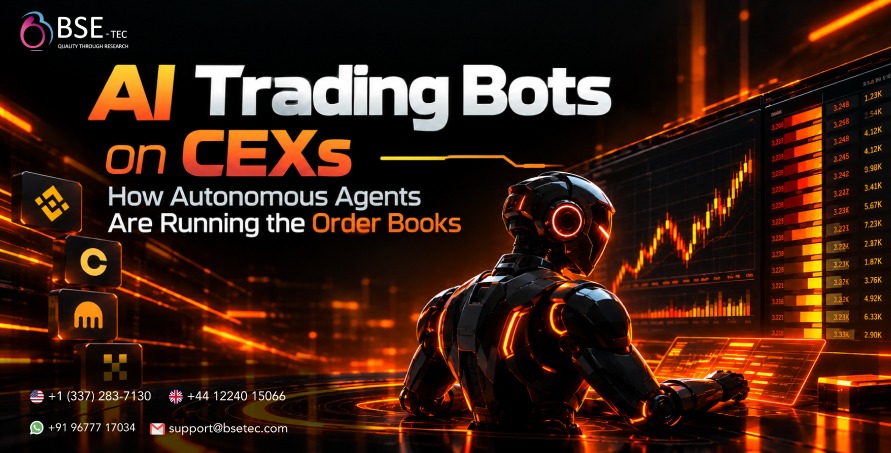
BSEtec is building a new generation of financial infrastructure where AI doesn’t stop at analysing markets. Autonomous agents can now connect with exchanges, interpret live market data, evaluate trading conditions, and execute orders within defined rules.
That changes the trading bot’s role.
Traditional algorithmic systems usually follow predefined strategies. Agentic trading systems can interpret context, select tools, adapt their workflow, and execute actions based on a broader objective.
In 2026, major crypto exchanges are moving closer to this model.
The shift is happening across MCP-based exchange connectivity, order-book intelligence, autonomous execution, programmable permissions, and AgentOps.
The bigger question is no longer whether AI can analyse a market.
Can an AI agent operate inside a live exchange without losing control of the capital behind it?
The Trading Bot Is Getting a Direct Line to the Exchange
For years, traders separated intelligence from execution.
An AI model could analyse sentiment, identify patterns, or generate a strategy. Then, however, a human or separate trading system had to take that recommendation and place the order.
That gap is disappearing.
In April 2026, Gemini introduced Agentic Trading, allowing AI agents to connect through MCP and place trades, monitor markets, and manage risk on behalf of users. The service launched through a regulated U.S.-based exchange, making the move particularly relevant for institutional and professional-market infrastructure.
Meanwhile, OKX launched its Agent Trade Kit as an exchange-native MCP toolkit. It allows compatible AI clients to access market data and execute spot, perpetual, and conditional algorithmic orders through a unified interface.
The infrastructure is therefore moving from:
AI analysis → Human execution
toward:
Market data → AI reasoning → Risk evaluation → Order execution
That is the real beginning of agentic trading infrastructure.
MCP Is Becoming the Bridge Between AI and CEXs
The interesting part is not simply that exchanges provide APIs.
APIs have existed for years.
The newer shift comes from making exchange capabilities understandable and accessible to AI agents through Model Context Protocol (MCP).
Instead of building every integration from scratch, an agent can interact with structured tools for market data, balances, positions, orders, and trading workflows.
OKX’s Agent Trade Kit, for example, connects AI clients directly to exchange functionality through MCP. Its toolkit includes market data, order execution, account management, algorithmic orders, and trading-bot capabilities.
Consequently, the exchange becomes more than a place where orders are submitted.
It becomes a tool environment that an autonomous agent can reason over.
For developers building financial agents, that distinction matters because the agent can now move through the complete workflow instead of stopping at analysis.
Order Books Are Becoming the Agent’s Real-Time Decision Layer
Price prediction alone does not create a sophisticated trading agent.
Real execution depends on liquidity, spreads, market depth, funding rates, order flow, volatility, and available execution paths.
That is why order-book intelligence is becoming an important part of agentic trading.
An autonomous agent can combine live order-book information with its trading objective and decide whether to enter, wait, modify an order, or avoid execution altogether.
For instance, an agent might identify a trading signal but detect insufficient liquidity around the intended price. Instead of blindly executing, it could adjust the order strategy or wait for a better market condition.
The intelligence therefore moves beyond:
“Will the price rise?”
toward:
“Given the current market structure, should I execute, how should I execute, and what risk am I accepting?”
That is a much more complex engineering problem.
From Recommendation to Real Order Execution
This is where the 2026 trend becomes commercially significant.
Gemini’s agentic trading infrastructure allows agents to move from market monitoring to actual trading actions. OKX similarly exposes execution capabilities through its Agent Trade Kit.
Coinbase has pushed the model further with Coinbase for Agents, launched in June 2026. Its infrastructure allows agents to trade and execute workflows within user-defined limits. Coinbase also expanded its agentic stack to support payments for data and model access, creating a loop where an agent can identify a signal, pay for additional information, and then place a trade.
That creates a new financial workflow:
Detect → Research → Evaluate → Pay for Data → Decide → Execute → Monitor
The agent is no longer simply a trading assistant.
It is becoming an autonomous financial operator.
The Most Important Feature May Not Be Intelligence
Giving an AI access to an exchange is easy compared with controlling what it can do once connected.
That is why guardrailed autonomy may become more important than raw model intelligence.
Binance Agent OS, launched in August 2026, lets users connect agents to Binance services with configurable permissions. Its infrastructure supports access to market data and trading while using dedicated sub-accounts and controls around agent access. Binance also provides mechanisms to revoke permissions and stop agent access.
Coinbase’s Agentic Wallets follow a similar principle. Its infrastructure includes transaction limits, session spending caps, secure key isolation, and transaction screening.
The message is clear:
Autonomy does not mean unlimited access.
A production-grade trading agent needs boundaries around capital, markets, order size, execution frequency, permissions, and emergency intervention.
AgentOps Enters the Trading Stack
Once an AI agent can make real trades, conventional monitoring is no longer enough.
A trading platform needs to know:
- What market data influenced the decision?
- Which strategy or objective did the agent follow?
- What tools did it access?
- Why did it place the order?
- What risk limits applied?
- Did the execution remain within those limits?
- What happened after the trade?
This creates a new operational layer: AgentOps for financial agents.
The goal is not merely to record successful or failed orders. Instead, teams need decision-to-execution observability across the entire agent workflow.
For institutional and enterprise environments, that becomes especially important because auditability, policy enforcement, and intervention cannot remain separate from trading infrastructure.
BSEtec: Building AI Trading Systems With Execution and Control
BSEtec is positioned directly at this intersection of AI algorithmic trading, autonomous agents, blockchain infrastructure, predictive DeFi oracles, wallets, and secure execution.
Its AI Algorithmic Trading and Predictive DeFi Oracle infrastructure focuses on systems that can analyse markets, forecast price movements, and support automated execution with defined boundaries and accountability.
For autonomous financial systems, however, trading intelligence is only one layer.
The surrounding architecture also needs secure wallets, permission controls, identity, market-data infrastructure, execution logic, monitoring, and risk management.
BSEtec’s autonomous Bitcoin agent development approach reflects this architecture, with scoped wallets, spending limits, whitelisted actions, and multi-signature requirements designed into autonomous execution workflows.
That makes the opportunity much larger than building another trading bot.
It means creating financial agents that can reason, execute, monitor, and remain within defined boundaries.
The Real-Time Test: Can Autonomy Actually Make Money?
More autonomy does not automatically mean better trading performance.
That distinction matters.
Recent real-world testing of AI trading agents has shown mixed results. In one 2026 test reported by Barron’s, Claude and Gemini produced modest gains while ChatGPT recorded a small loss over the evaluated trading period. The results reinforce an important point: an agent can execute trades autonomously without necessarily producing durable profitability.
Therefore, the winning architecture cannot rely on model intelligence alone.
Execution quality, transaction costs, liquidity, risk controls, strategy validation, market conditions, and continuous evaluation still determine outcomes.
Autonomous execution is an infrastructure capability — not a guarantee of returns.
What Comes Next: From Trading Bots to Agentic Financial Systems
The next phase will likely move beyond individual trading agents.
Agents could monitor multiple markets, purchase specialised market data, coordinate with other agents, manage portfolios, execute approved strategies, and pay for external services.
Coinbase’s expansion into agentic trading and machine-to-machine payments already points toward this broader direction.
At the same time, exchange infrastructure is becoming increasingly agent-accessible through MCP, while permission systems are becoming part of the architecture rather than an afterthought.
Eventually, the trading stack may look less like a human-operated exchange terminal and more like an autonomous financial operating environment.
The important question will shift from:
“Can an AI trade?”
to:
“Can an AI trade intelligently, explain its decisions, respect its limits, and recover when conditions change?”
Final Thoughts
AI trading bots are moving beyond signals and recommendations.
In 2026, major exchanges are opening their infrastructure to autonomous agents through MCP, direct execution tools, agentic wallets, programmable permissions, and machine-readable market data.
However, the real opportunity is not simply giving an AI agent access to an order book.
It is building the infrastructure around that access.
BSEtec combines AI algorithmic trading, autonomous blockchain agents, predictive market infrastructure, wallets, smart contracts, and security-focused controls to help businesses build financial systems where AI can analyse, decide, execute, and remain accountable.
The next generation of trading infrastructure will not be defined by bots that trade faster.
It will be defined by agents that can trade intelligently — while staying inside the rules.