Blockchain Development adoption is accelerating faster than ever. Yet, while organizations are eager to embrace decentralized technologies, many projects never reach production.
The challenge isn’t blockchain itself; it’s building blockchain solutions that are secure, scalable, compliant, and capable of integrating with existing enterprise systems.
In 2026, blockchain has moved beyond cryptocurrency. Banks are tokenizing financial assets, manufacturers are creating transparent supply chains, healthcare providers are securing patient records, and governments are digitizing public services. According to industry forecasts, the global blockchain market is projected to surpass USD 390 billion by 2032, reflecting one of the fastest growth rates in enterprise technology.
However, despite this momentum, businesses continue to encounter technical and operational roadblocks during blockchain implementation.
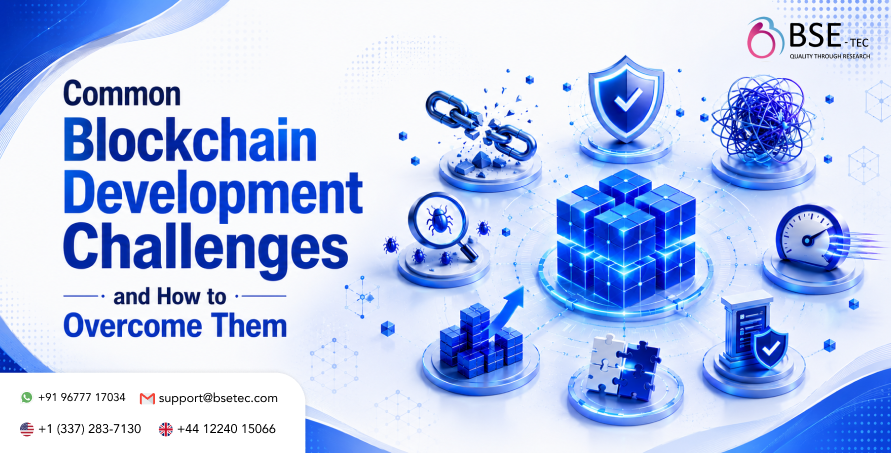
This article explores the biggest blockchain development challenges organizations face today—and, more importantly, how modern development strategies help overcome them.
The Reality Behind Enterprise Blockchain Development Projects
Many companies begin blockchain initiatives with ambitious goals.
Some want to automate contracts.
Others aim to tokenize assets.
Many hope to improve transparency across complex supply chains.
While these objectives are achievable, success depends on making the right architectural decisions from the beginning. Choosing an unsuitable blockchain network, overlooking compliance requirements, or deploying unaudited smart contracts can quickly transform an innovative idea into an expensive setback.
This is why successful blockchain adoption starts with strategic planning rather than coding.
Challenge 1: Scaling Beyond the Pilot Stage
Launching a blockchain proof of concept is relatively straightforward. Scaling it to support thousands—or even millions—of transactions is an entirely different challenge.
As user activity grows, businesses often experience slower transaction processing, higher network fees, and performance bottlenecks. Public blockchains, in particular, can struggle during periods of heavy demand.
How Leading Companies Solve It
Rather than relying on a single blockchain, enterprises are increasingly adopting Layer-2 networks, modular blockchain architectures, application-specific chains, and zero-knowledge rollups. These technologies significantly increase throughput while reducing costs.
At BSEtec, scalability is built into every blockchain architecture from day one, ensuring platforms remain efficient as business demand grows.
Challenge 2: Security Isn’t Optional
One overlooked vulnerability can compromise an entire blockchain ecosystem.
Although blockchain networks themselves are highly secure, smart contracts, wallets, APIs, and user authentication remain common targets for attackers. The increasing sophistication of cyber threats makes proactive security essential.
The Modern Security Approach
Today’s enterprise blockchain platforms combine smart contract audits, formal verification, penetration testing, multi-party computation (MPC) wallets, encrypted key management, and continuous monitoring.
BSEtec follows a security-first development methodology, helping organizations reduce risks before applications reach production.
Challenge 3: Regulations Continue to Evolve
Blockchain regulation has become significantly clearer than it was just a few years ago. However, compliance requirements continue to evolve across different countries.
Organizations developing blockchain applications must now consider identity verification, anti-money laundering requirements, privacy regulations, auditability, and digital asset governance from the very beginning.
Instead of treating compliance as a final step, successful enterprises now build regulatory readiness directly into their platforms.
Challenge , 4: Connecting Multiple Blockchain Networks
The blockchain ecosystem has become increasingly diverse. Businesses rarely rely on just one network. Instead, they often operate across Ethereum, Polygon, Solana, Hyperledger, Avalanche, and other blockchain ecosystems.
Without interoperability, assets and data become isolated, limiting the full value of blockchain adoption. Cross-chain bridges, interoperability protocols, blockchain APIs, and omnichain messaging frameworks are becoming essential components of enterprise blockchain infrastructure.
BSEtec specializes in building blockchain ecosystems where different networks communicate securely and efficiently.
Challenge , 5: Integrating Blockchain with Existing Business Systems
Very few organizations build entirely new technology stacks. Most enterprises already depend on ERP systems, CRMs, cloud platforms, payment gateways, and internal databases.
Modern blockchain solutions must therefore complement, not replace, existing infrastructure.
API-driven architecture, middleware integration, cloud-native deployment, and modular microservices enable blockchain to fit naturally into existing enterprise environments.
Challenge , 6: Delivering a User Experience People Actually Enjoy
One of blockchain’s biggest historical weaknesses has been usability.
Lengthy wallet setup, complex authentication, gas fees, and confusing interfaces have discouraged mainstream adoption. Fortunately, the user experience has changed dramatically in 2026.
Embedded wallets, account abstraction, gasless transactions, biometric authentication, and AI-powered onboarding now allow blockchain applications to feel as intuitive as traditional mobile apps.
This shift is helping organizations attract and retain significantly more users.
What Forward-Thinking Businesses Are Doing Differently
Rather than focusing only on blockchain development, leading organizations are investing in complete blockchain ecosystems.
They prioritize scalable infrastructure, regulatory compliance, seamless interoperability, AI-powered automation, enterprise-grade security, and intuitive user experiences from the outset.
This holistic approach reduces long-term costs, accelerates deployment, and improves adoption.
Why Businesses Choose BSEtec
Blockchain success requires more than technical expertise; it requires strategic guidance, future-ready architecture, and continuous innovation.
As a trusted Blockchain development company, BSEtec helps startups, enterprises, fintech companies, healthcare providers, and logistics organizations build blockchain platforms that are secure, scalable, and designed for long-term growth.
Our expertise includes custom blockchain development, smart contract engineering, decentralized applications, enterprise blockchain consulting, tokenization platforms, cryptocurrency exchange development, MPC wallet integration, blockchain APIs, cross-chain solutions, and ongoing support.
Whether you’re launching a new blockchain product or modernizing enterprise operations, BSEtec delivers solutions aligned with the latest trends and business requirements.
Looking Ahead
Blockchain development in 2026 is no longer about experimenting with emerging technology. It is about creating resilient digital infrastructure that powers real business outcomes.
Organizations that address scalability, security, compliance, interoperability, and user experience from the start will be best positioned to lead the next wave of digital transformation.
With the right strategy and an experienced technology partner like BSEtec, blockchain becomes more than an innovation; it becomes a competitive advantage.