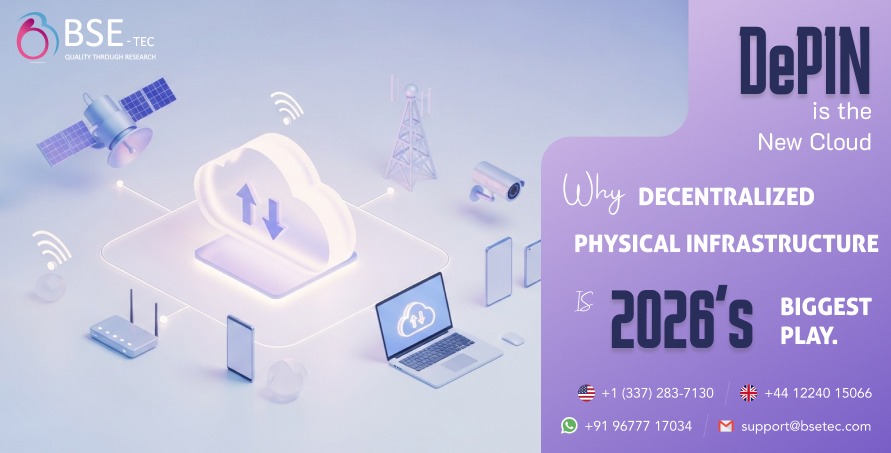
What if the cloud didn’t belong to a few giants—but to everyone? For years, we’ve relied on the cloud without a second thought. But now, things are shifting. Enter DePIN—a new way of building infrastructure where people don’t just use the system, they own and power it together.
In simple terms, the cloud is evolving—and this next version is more open, shared, and powerful than ever.
That’s why many are calling DePIN the next version of the cloud.
So, What Exactly is DePIN?
Think of DePIN (Decentralized Physical Infrastructure Networks) as the Uber-fication of the world’s physical hardware, but without the corporate middleman.
Essentially, it is a way to build and maintain real-world infrastructure—such as cell towers, sensors, or data centers—using blockchain technology and token rewards to incentivize individuals to contribute their own hardware.
How it works
Instead of a single giant company (like Amazon or AT&T) spending billions to build a network, a DePIN project crowdsources it.
First, an individual buys a piece of hardware (like a specialized Wi-Fi router or a weather sensor) and plugs it in at their home. Next, that hardware provides a service to the network, such as boosting local internet coverage or collecting climate data. Consequently, the owner of the hardware is rewarded with crypto tokens for their contribution. Finally, businesses or consumers pay to use this decentralized network, often at a much lower cost than traditional providers.
Why It’s a Big Deal
- Cost Efficiency: Because the community owns the hardware, the company doesn’t have the massive overhead of traditional infrastructure.
- Resilience: Unlike a central server that can go down, a DePIN is spread across thousands of global locations.
- Permissionless: Anyone, anywhere, can join the network and start earning.
So instead of companies owning everything, what if everyone could contribute?
From Centralized Power to Community Networks
The shift from centralized power to community-driven networks represents a massive structural change in how our world operates. Historically, major infrastructure was controlled by a few massive entities; however, we are now seeing a pivot toward decentralized models.
1. The Era of Centralization – For decades, we relied on Centralized Power. In this model, a single corporation or government owns all the assets, sets the pricing, and controls the data.
- For instance, if you wanted internet access, you had to go through a massive ISP.
- While this provided stability, it often resulted in high costs and a single point of failure—if the central hub went down, everyone lost service.
2. The Shift to DePIN
Recently, Decentralized Physical Infrastructure Networks (DePIN) have emerged to challenge this status quo. Instead of waiting for a company to build a cell tower in a rural area, local communities can now build the network themselves.
3. How the Transition Functions
The move toward community networks relies on a specific sequence of incentives:
- Initially, a protocol is launched that promises rewards (tokens) to anyone who provides a service (like hosting a server or a sensor).
- Consequently, thousands of individuals around the world set up hardware, creating a massive, distributed grid almost overnight.
- Moreover, because there is no corporate headquarters to maintain, the service becomes significantly cheaper for the end user.
The transition from centralized power to community networks is more than just a technical upgrade; rather, it is a democratization of the physical world, moving the power literally and figuratively back into the hands of the people.
Why 2026 is the Turning Point
The convergence of AI demand, regulatory maturity, and hardware saturation has made this year the definitive inflection point for DePIN.
1. The AI Compute Crunch
Consequently, the primary driver of DePIN’s dominance in 2026 is the insatiable hunger for GPU power. Traditional cloud providers like AWS and Azure have struggled to keep up with the exponential growth of AI inference and training.
- Cost Efficiency: Decentralized networks like Akash and Render now offer compute resources at 45% to 60% less than legacy providers.
- Accessibility: Small-to-medium AI startups, previously priced out of the market, are now using DePIN to run burst workloads that don’t require the massive overhead of a centralized data center.
2. Regulatory Clarity and Enterprise Trust
Furthermore, 2026 marks the year when the Wild West era of crypto ended. With the full implementation of global frameworks (such as the US Clarity Act and Europe’s MiCA), corporations finally have the legal green light to integrate decentralized assets into their balance sheets.
- SLA Enforcement: New cryptographic slashing mechanisms ensure that if a provider’s hardware fails, the user is automatically compensated, providing the reliability enterprises demand.
- Institutional Inflow: We are seeing TradFi (Traditional Finance) and DeFi converge, with real estate and energy grids being tokenized and managed on-chaihttps://www.bsetec.com/defin.
3. Maturity of the Invisible User Experience
In addition to technical and legal shifts, the user experience (UX) has finally evolved. In 2026, a developer can deploy an application to a decentralized network using a standard credit card, without ever needing to touch a crypto wallet or understand gas fees.
- Abstraction Layers: The complex blockchain mechanics are now hidden behind familiar interfaces, making DePIN indistinguishable from traditional cloud services to the end-user.
4. Real-World Scale and Proven Utility
Ultimately, the data speaks for itself. By early 2026, DePIN networks will have moved beyond speculation:
- Wireless: Networks like Helium have millions of active nodes, providing genuine 5G offloading for major telecom carriers.
- Mapping: Hivemapper has now mapped over 35% of the world’s roads, providing real-time data that is fresher and cheaper than Google Maps’ proprietary datasets.
And this is where DePIN starts becoming more than just an idea
3 Simple Ways DePIN is Already Changing Everyday Life
- Wireless Internet: You put a small box in your window. It provides 5G to your neighbors. You earn money for every gigabyte they use. No more relying on giant telecom monopolies.
- Smart Maps: You put a dashcam in your car. As you drive to work, it maps the road in high-def. You earn rewards for keeping the map live, providing data that is more accurate than Google Maps.
- AI Computing: An AI company needs massive power to think. Instead of renting a supercomputer from Amazon, they use the idle power from thousands of gaming PCs (like yours) and pay the owners directly.
Where BSEtec Fits Into the DePIN Movement
Essentially, BSEtec acts as the software backbone for the DePIN movement. Rather than building physical hardware, they provide the white-label blockchain frameworks and smart contracts necessary to run decentralized networks.
How BSEtec Integrates with DePIN
Initially, BSEtec established itself as a leader in clone scripts and white-label solutions. Moving forward, they have pivoted to support the specific demands of decentralized infrastructure in several key ways:
- Smart Contract Automation: DePIN relies on automated payments for resource providers (like someone sharing their Wi-Fi or storage). BSEtec provides the underlying smart contracts that handle these micro-transactions securely.
- Tokenomics Design: Furthermore, launching a DePIN project requires a native token to incentivize users. BSEtec assists in developing the Reward-and-Burn models necessary to keep these networks sustainable.
- Multi-Chain Integration: In addition to basic blockchain support, their solutions often work across various networks (like Solana or Polygon), which are the preferred homes for high-frequency DePIN data.
The Bridge Philosophy
Consequently, BSEtec shouldn’t be viewed as a competitor to DePIN giants like Helium or Hivemapper. Instead, they should be seen as the toolkit provider. To put it another way, if DePIN is a gold rush, BSEtec is the company selling the high-tech shovels.
Ultimately, their role is to lower the barrier to entry. By doing so, they allow smaller startups to deploy decentralized physical hardware across the globe using pre-vetted, secure software stacks.
The success of a DePIN project depends heavily on the Flywheel Effect.
- Hardware is deployed.
- Users earn tokens.
- Network utility increases.
- Token value rises, attracting more hardware.
BSEtec provides the software engine that keeps this cycle spinning.
The Bigger Picture: Reinventing the Cloud, Not Replacing It
To begin with, DePIN isn’t here to replace the cloud—it’s here to enhance it.
In fact, the cloud brought convenience, speed, and scalability into our daily lives. Now, DePIN builds on that foundation by adding shared ownership, flexibility, and cost efficiency. As a result, instead of choosing one over the other, businesses can combine both—creating a hybrid model where centralized systems provide stability, while decentralized networks offer openness and scale.
In other words, it’s not a replacement—it’s an evolution. Just like smartphones didn’t replace computers but extended how we use them, DePIN expands what the cloud is capable of.
Final thoughts
DePIN is not just evolving the cloud—it’s redefining it into something more open, shared, and powerful. As this shift accelerates in 2026, early adopters will have the biggest advantage.
As a leading Blockchain development company, BSEtec helps businesses turn this opportunity into reality—making the move to DePIN simple, scalable, and future-ready.