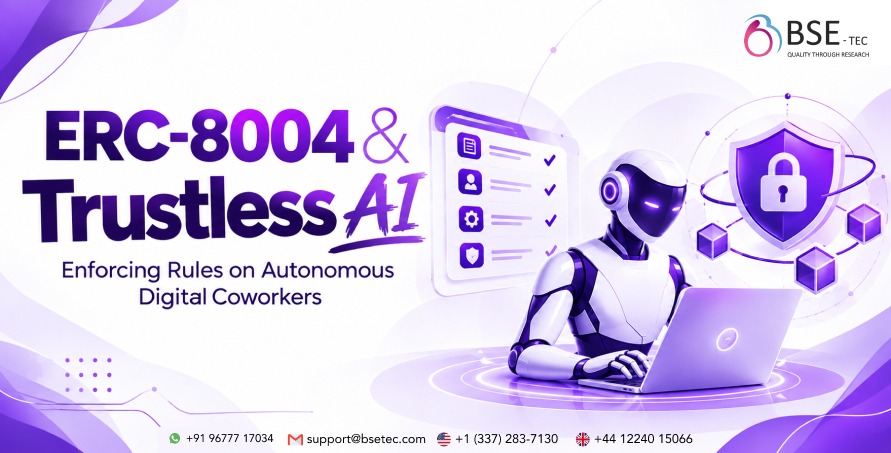
AI agents are moving from assistants that answer questions to digital coworkers that can make decisions, use tools, manage workflows, interact with other agents, and execute transactions.
But there is a problem.
When an AI agent starts acting independently, businesses need more than intelligence. They need to know who the agent is, what it is allowed to do, how it has performed, and whether its actions can be verified.
This is where ERC-8004 and trustless AI become important.
At BSEtec, we work at the intersection of AI, blockchain, smart contracts, Web3, and autonomous systems to help businesses move toward controlled AI automation. Instead of allowing autonomous agents to operate as black-box software, BSEtec can help design systems where identity, permissions, transactions, and execution rules are supported by blockchain infrastructure.
The bigger opportunity is not simply making AI agents smarter.
It is making them accountable enough to act.
When AI Becomes a Digital Coworker, Trust Becomes Infrastructure
Consider an AI procurement agent working for a global enterprise.
It can search suppliers, compare prices, negotiate terms, place an order, and initiate payment. However, before allowing that agent to operate independently, the business needs clear answers.
Who created the agent?
What can it access?
How much can it spend?
Has it completed similar tasks successfully?
Can another system verify its work?
Traditional authentication can confirm access. Yet, authentication alone does not establish performance history, independent validation, or machine-readable reputation.
Consequently, autonomous AI needs a broader trust layer.
That is the problem ERC-8004 is designed to address.
ERC-8004 Gives Autonomous Agents a Verifiable Identity
ERC-8004, titled “Trustless Agents,” proposes blockchain-based infrastructure for discovering, selecting, and interacting with AI agents across organizational boundaries without requiring pre-existing trust.
Instead of treating an AI agent as an anonymous API endpoint, the standard introduces three important registries:
- Identity Registry — provides a portable on-chain identity for an agent.
- Reputation Registry — provides standardized feedback signals about agent performance.
- Validation Registry — records independent verification of an agent’s work.
This creates a simple trust architecture:
Identity → Reputation → Validation → Controlled Action
As a result, one AI agent could discover another agent, inspect its identity, review available reputation signals, and request validation before trusting the output.
That becomes increasingly important as AI agents begin working across companies and ecosystems.
Trustless AI Does Not Mean “Trust the AI”
The phrase trustless AI can sound misleading.
It does not mean businesses should blindly trust autonomous AI.
Instead, the idea is to reduce the need for pre-existing human or institutional trust by introducing verifiable mechanisms around agent interactions.
For example, an enterprise could allow an AI research agent to collect market information. Another agent could validate the result before it reaches a financial workflow.
Similarly, a purchasing agent might have permission to spend only within a predefined limit. If its transaction exceeds that limit, the blockchain-based control layer can reject the action.
Therefore, the AI remains responsible for reasoning, while deterministic infrastructure controls what it can actually execute.
AI decides.
Blockchain records.
Smart contracts enforce.
Validation provides evidence.
That separation is crucial for enterprise-grade autonomous systems.
The Three Layers Behind Trustworthy AI Agents
ERC-8004 becomes more interesting when its components are viewed as a complete agent trust stack.
1. Identity: “Who Are You?”
An agent needs a persistent identity that can be discovered across systems.
The ERC-8004 Identity Registry uses an on-chain identifier and registration information that can point to services such as A2A, MCP, ENS, or other endpoints.
Therefore, an agent can become more than a temporary software process.
It can have a recognizable digital identity.
2. Reputation: “How Have You Performed?”
Identity alone does not prove reliability.
A reputation layer can capture feedback signals such as success rate, response time, uptime, or other application-specific measurements.
This creates an important difference from conventional APIs.
An API tells you how to connect.
An agent reputation system can provide additional information about how the agent has performed.
3. Validation: “Did You Actually Do the Work?”
This is where trustless AI becomes particularly powerful.
ERC-8004 provides a Validation Registry through which agents can request independent verification. Validators can use approaches such as stake-secured re-execution, zkML verification, or trusted execution environment (TEE) oracles.
Consequently, businesses can move beyond simply asking an AI agent for an answer.
They can build workflows that ask:
Can this result be independently verified?
Where Autonomous Digital Coworkers Could Change Business
The technology becomes commercially interesting when AI agents start interacting with other systems without continuous human intervention.
AI Procurement: A procurement agent could discover suppliers, compare offers, negotiate approved terms, and initiate transactions.
However, spending limits and supplier permissions can remain enforced by deterministic rules.
Financial Operations: An AI finance agent could monitor transactions and prepare actions based on predefined policies.
Before execution, smart contracts or validation services could check limits, identity, and authorization.
AI-to-AI Commerce: One agent could discover another agent that provides data, computation, research, or specialized services.
Then, through programmable payments and verifiable identity, the agents could complete the transaction without requiring a human to coordinate every step.
Ethereum’s current AI-agent ecosystem already highlights agent-controlled wallets, autonomous transactions, agent-to-agent commerce, and verifiable AI as emerging use cases.
2026: AI Agents Are Moving Toward Verifiable Execution
The important shift in 2026 is not simply that AI agents are becoming more autonomous.
It is that the supporting infrastructure is becoming more structured.
ERC-8004 connects agent discovery with identity, reputation, and validation. Meanwhile, blockchain-based wallets and smart contracts can provide transaction authority and programmable restrictions.
In addition, technologies such as zkML and TEEs can provide additional verification mechanisms for AI computation. Ethereum’s current AI-agent documentation specifically identifies these approaches as ways to make off-chain AI execution more verifiable.
Therefore, the emerging architecture looks less like:
AI → API → Action
and more like:
AI Agent → Identity → Policy → Validation → Smart Contract → Action
That difference could become critical as autonomous systems handle higher-value business operations.
BSEtec: Building the Trust Layer Around Autonomous AI
This is where BSEtec can help businesses move from experimental AI agents toward controlled autonomous systems.
BSEtec combines AI development, blockchain development, smart contracts, Web3 infrastructure, AI-agent architecture, and enterprise automation to design solutions around real operational requirements.
Depending on the use case, the architecture can include:
- AI Agent Development — autonomous agents designed for specific business workflows.
- Blockchain-Based Agent Identity — verifiable identities and permission structures.
- Smart Contract Automation — deterministic rules for transactions and workflows.
- Agent Wallet Integration — controlled digital-asset operations for autonomous systems.
- Reputation & Validation Layers — mechanisms for evaluating agent performance and execution.
- AI + Blockchain Integration — connecting intelligent decision-making with verifiable infrastructure.
BSEtec’s existing work around AI agent identity, smart-contract-controlled automation, and blockchain-based AI trust provides a natural foundation for this direction.
You can also connect this topic with BSEtec’s work on AI agents using crypto wallets, especially for businesses exploring machine-to-machine transactions and autonomous commerce.
What Comes Next: From AI Assistants to Accountable Digital Workers
The next generation of AI systems may not simply answer questions.
They could hire other agents, purchase services, manage digital assets, execute workflows, and coordinate operations.
However, autonomy without controls creates unnecessary risk.
That is why identity, reputation, validation, permissions, and programmable execution are becoming increasingly important.
ERC-8004 does not solve every trust problem. In fact, its own specification notes that reputation can face Sybil or spam attacks, while an on-chain registration cannot by itself guarantee that an advertised capability is functional or non-malicious.
So, the future will likely depend on combining multiple layers rather than relying on one standard.
Final Thoughts
ERC-8004 represents an important step toward making autonomous AI agents identifiable, discoverable, and verifiable across organizational boundaries.
As AI moves from assistants to digital coworkers, businesses will need more than powerful models. They will need infrastructure that can define permissions, evaluate reputation, validate execution, and enforce rules before autonomous actions affect money, data, or critical operations.
That is where BSEtec can create value.
By combining AI agents, blockchain identity, smart contracts, Web3 infrastructure, wallet integration, and validation mechanisms, BSEtec can help businesses build autonomous systems that are not only intelligent but also controlled, auditable, and designed for real-world execution.
The future of AI may not be about giving agents unlimited freedom.
It may be about giving them the right identity, the right permissions, and the right rules to act independently.