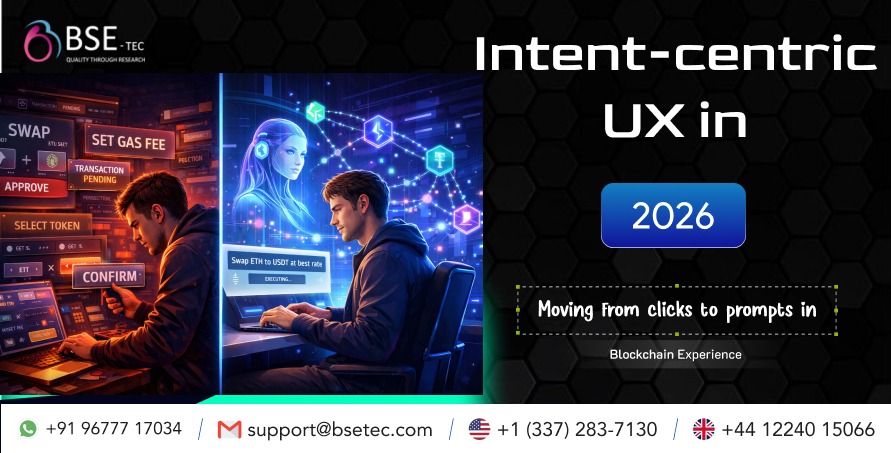
Clicks are fading—and now, prompts are taking over. In 2026, users no longer want to navigate; instead, they simply express and get things done. However, in blockchain, where complexity slows adoption, this shift becomes essential. Because ultimately, only simple, intent-driven experiences can unlock true mass adoption.
Why Blockchain UX Still Feels Complicated
Blockchain technology offers incredible power, but for the average user, the interface still feels like a puzzle.
Here is a breakdown of why:
- No Safety Net — To begin with, there’s no forgot password option—instead, users rely on private keys. As a result, one mistake can lead to permanent loss.
- Gas Fee Barrier — every action needs gas fees in specific tokens. Therefore, even simple transactions require extra steps beforehand.
- Network Fragmentation — Additionally, assets are spread across multiple chains. Consequently, users must bridge them manually, which feels complex and risky.
- Cryptic Terminology — Finally, technical terms like slippage and RPC create confusion. Thus, blockchain feels less user-friendly and more developer-focused.
This gap creates the need for a more intuitive model
Enter Intent-Centric UX:
Intent-Centric UX shifts the digital experience from How to do it to What to achieve. Traditionally, users had to learn a software’s steps; now, the software learns the user’s goal.
Key Components
- User Intent: The starting point is a high-level goal, such as Send $500 to Alex.
- Solver Logic: Subsequently, an AI-driven solver finds the most efficient path to execute that goal.
- Abstraction: Consequently, technical hurdles—like selecting networks or navigating menus—are hidden from the user.
The Evolution of Interaction
- Command-Line (CLI): Users memorize syntax.
- Graphical (GUI): Users click buttons.
- Intent-Centric (IX): Users simply state their desired outcome.
Strategic Advantages
- Speed: Because the system handles the how, task completion becomes instantaneous.
- Accessibility: Furthermore, it lowers the barrier for complex technologies, making them usable for non-experts.
- Predictive Power: Finally, the interface evolves in real-time based on the user’s current context.
This leads to a major transformation in UX
From Clicks to Prompts: The Core Transformation
To make this transformation from clicks to prompts truly resonate, we have to look at it as a shift from manual labor to delegated intent. In 2026, the user is no longer the pilot; they are the high-level strategist.
The Core Transformation: From Procedural to Declarative
The traditional blockchain experience was procedural, requiring a user to click through every step of a transaction. In contrast, the modern Intent-Centric UX is declarative, where the user simply defines the end state they want to achieve.
- The Click Era: Users had to bridge assets manually, swap for gas tokens, and calculate slippage. Consequently, the barrier to entry was high, as every click was a potential point of failure.
- The Prompt Era: Users now provide a high-level command (e.g., Yield farm my USDC on the safest L3). Subsequently, the underlying infrastructure—powered by Solvers—competes to find the most efficient path to fulfill that command.
Comparative Analysis: 2024 vs. 2026
| Feature | Legacy UX (The Click Chain) | Modern UX (The Prompt Chain) |
| Workflow | Linear & Manual (A – B – C) | Outcome-Based (A Final Result) |
| Complexity | User-facing (Gas, RPCs, Bridges) | System-facing (Abstracted behind prompts) |
| Efficiency | Limited by user knowledge | Optimized by professional Solvers. |
| Onboarding | Hours of learning | Seconds of prompting |
Why This Matters for Scaling
The shift to prompts is not just a UI upgrade; it is a structural necessity for mass adoption.
- Abstracting the Infrastructure: As a result of this shift, the specific blockchain being used becomes irrelevant to the end user. Furthermore, this allows for Invisible Web3, where the benefits of decentralization exist without the friction of manual management.
- Hyper-Personalization: Moreover, AI-integrated prompts allow the wallet to learn user preferences over time. Therefore, the system doesn’t just execute orders—it anticipates the most cost-effective way to manage a user’s digital footprint.
The Click era was about mastering the machine. The Prompt era is about the machine mastering the complexity so the user can focus on the value.
When applied correctly, choosing the right partner matters
BSEtec’s Approach to Intent-Driven UX
At BSEtec, we believe users shouldn’t have to figure out the platform—the platform should understand them. Instead of forcing users to click through steps, we’ve evolved from traditional button-based design to Intent-Driven UX.
Here’s how we bring that vision to life:
1. Goal-First Design — To begin with, BSEtec prioritizes the user’s objective over traditional menu navigation. Instead of forcing users to click through multiple pages, we surface direct actions—like Trade or Pay—to ensure a fast, frictionless path to the outcome.
2. Technical Abstraction — Furthermore, we specialize in making complex technology invisible. By using tools like gas abstraction, BSEtec hides the backend plumbing of blockchain, giving users a clean, simple experience while the system handles the heavy lifting.
3. AI-Driven Anticipation — In addition to simplicity, we integrate proactive AI to predict the user’s next move. This transition from reactive to predictive design reduces cognitive load, meaning BSEtec-built platforms feel intuitive because they anticipate needs before the user even has to search.
4. Universal Consistency — Finally, we ensure a seamless experience across all screens. Using frameworks like Flutter and React Native, BSEtec guarantees that the user’s intent remains consistent and the interface stays familiar, whether they are on a mobile app or a desktop browser.
Real-World Experience: From Complexity to Simplicity
In 2026, Intent-Centric UX transforms blockchain from a series of manual clicks into a simple, prompt-driven dialogue. Initially, users had to navigate bridges and gas fees; however, we have now shifted toward focusing on outcomes rather than technical steps.
The Shift to Simplicity:
- From How to What: Instead of manually selecting networks, you simply state your goal. Consequently, the solver network handles the backend complexity.
- Gas Abstraction: You no longer need specific native tokens for fees. Instead, you can pay in any asset, such as USDC, making the experience seamless.
- Unified Liquidity: Your assets feel like one pool across all layers. Furthermore, this invisible infrastructure ensures that transactions either succeed as requested or don’t execute at all.
Ultimately, this transition replaces technical hurdles with human-readable prompts. As a result, the blockchain becomes an invisible engine powering a simplified real-world experience.
At the center of this transformation is BSEtec—driving innovation with intent-driven blockchain platforms that convert complex processes into seamless, prompt-based experiences. By blending AI with blockchain expertise, BSEtec empowers businesses to deliver simplicity without sacrificing performance or control.
As a result, this shift doesn’t just improve usability—it creates real advantages, including faster operations, higher adoption, and better business efficiency.
This transformation leads to clear advantages for users and businesses
Key Benefits of Intent-Centric Blockchain UX
1. From How to What. — Users no longer follow every step manually; instead, they simply state the desired outcome. As a result, complexity is hidden, and blockchain feels like a Web2 app.
2. Hyper-Efficiency via Solvers — Rather than finding the best deals themselves, solvers handle it automatically. Consequently, users get better prices and lower slippage without expertise.
3. Gas and Chain Abstraction — Users don’t worry about chains or gas tokens anymore. Instead, the system manages it, reducing friction completely.
4. Built-in Security Guardrails — By defining outcomes, transactions become safer. Therefore, users are protected from unwanted actions or hidden risks.
What the Future Looks Like
The future of Intent-Centric UX shifts from how to use to what to achieve. Instead of complex interfaces, AI and NLP enable simple, natural interactions. As a result, experiences become more personalized and effortless. Ultimately, technology turns invisible—focused purely on user goals.
Conclusion: The Prompt-First Future
The shift from clicks to intent is no longer a trend—it’s the future. Instead of navigating complexity, users now expect simple, goal-driven experiences. Clearly, simplicity is the key to unlocking true blockchain adoption.
In a world shifting from clicks to intent, the leaders will be those who simplify complexity—and with BSEtec, a trusted Blockchain development company, the future is already here.