If your company hired 1,000 new employees tomorrow, you would immediately start thinking about management, governance, reporting structures, performance reviews, and security controls. Now imagine hiring 1,000 workers that never sleep, never take breaks, can process millions of data points every hour, and can collaborate in real time. That is exactly what many enterprises are doing in 2026. The difference is that these workers are not human. They are AI agents.
Across industries, organizations are moving beyond simple AI assistants and building what many technology leaders now call digital workforces. Unlike traditional chatbots, modern AI agents can access systems, execute workflows, communicate with other agents, make operational decisions, and complete tasks with minimal human intervention.
According to recent enterprise AI adoption research, more than half of large organizations are already piloting or deploying autonomous AI agents in production environments, while enterprise spending on agentic AI infrastructure continues to accelerate throughout 2026. Businesses are no longer asking whether AI agents can create value. Instead, they are asking how thousands of agents can be managed safely and efficiently.
That question is creating one of the fastest-growing technology categories of the year: AgentOps.
The Rise of the Digital Employee
One of the biggest technology shifts happening right now is the transition from AI assistants to AI employees.
An assistant waits for instructions. An employee completes work. As a result, that distinction is becoming increasingly important.
Today, a growing number of organizations are deploying specialized agents that perform roles traditionally handled by teams. For example, some agents analyze contracts, while others review compliance requirements. In addition, certain agents manage customer onboarding, whereas others monitor cybersecurity threats around the clock. Consequently, businesses are beginning to view AI not just as a support tool but as an active contributor to daily operations.
What’s even more interesting is that these agents are beginning to collaborate.
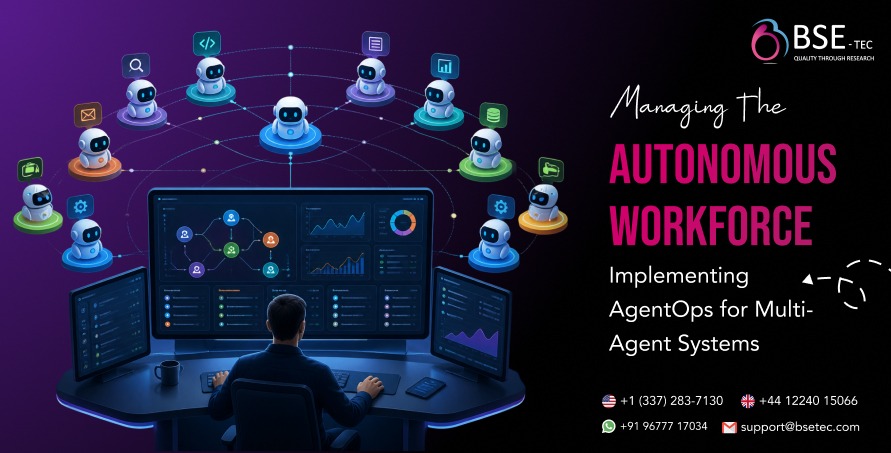
Instead of one AI system doing everything, multiple agents communicate with one another, share context, divide responsibilities, and coordinate workflows systematically. In practical terms, businesses are starting to build departments made up of AI agents. And once that happens, management becomes essential.
Why 2026 Is Different From Every Previous AI Wave
Previous generations of AI were primarily reactive.
You asked a question. The AI responded. The interaction ended there. Today’s agentic systems work differently.
Modern AI agents can operate continuously. They can monitor events, trigger actions, delegate responsibilities to other agents, and adapt to changing conditions without waiting for human instructions.
Furthermore, emerging Agent-to-Agent communication frameworks are enabling agents from different systems, platforms, and organizations to interact directly with one another. Industry leaders are investing heavily in these standards because they represent the foundation of the next generation of digital business operations.
This means your AI sales agent could eventually negotiate with another company’s procurement agent. Your logistics agent could coordinate directly with a supplier’s inventory agent. Your financial agent could reconcile transactions with a banking agent.
For the first time, autonomous systems are becoming participants in business processes rather than tools supporting them.
AI Agents Are Starting to Handle Money
One of the most significant developments of 2026 is the emergence of financial autonomy among AI agents.
Increasingly, organizations are experimenting with AI agents that can initiate transactions, manage subscriptions, purchase digital services, allocate cloud resources, and interact with blockchain-based payment systems.
In certain environments, agents are being equipped with digital wallets that allow them to execute predefined financial actions independently.
While this creates enormous opportunities for automation, it also introduces significant risks.
If an AI agent can spend money, approve transactions, or access sensitive financial systems, organizations need visibility into every action it performs. Suddenly, AgentOps is no longer just about monitoring workflows. It becomes a core business governance requirement.
The Hidden Problem Nobody Expected
As companies scale from ten agents to hundreds or thousands, a surprising challenge emerges.
The problem isn’t intelligence. The problem is coordination. Many organizations discover that multiple agents begin producing overlapping work, conflicting recommendations, duplicated actions, and unnecessary infrastructure costs. In some cases, businesses deploy more agents and accidentally reduce efficiency rather than increase it.
This is why leading enterprises are investing heavily in observability, orchestration, governance, and performance management. The goal is no longer to create more agents. The goal is to create smarter systems for managing them. And that is exactly what AgentOps provides.
Why This Trend Matters for BSEtec Clients
The rise of AgentOps is closely connected to the type of digital transformation projects businesses are actively pursuing today.
Organizations are no longer looking for isolated automation tools. They want intelligent ecosystems where AI agents, enterprise applications, cloud infrastructure, business processes, and customer experiences work together as a unified environment.
This is where BSEtec’s approach becomes particularly relevant.
As businesses move toward autonomous operations, BSEtec helps organizations build scalable AI ecosystems that combine intelligent automation, enterprise software development, workflow orchestration, blockchain integration, cloud-native architecture, and advanced digital transformation strategies.
More importantly, BSEtec understands that deploying AI agents is only the beginning. The long-term value comes from creating environments where those agents can operate securely, communicate effectively, integrate with enterprise systems, and remain aligned with business goals.
As AgentOps becomes a critical component of enterprise success, businesses increasingly need technology partners capable of connecting AI innovation with operational execution. That connection is exactly where BSEtec delivers measurable value.
The Future of Work Has Already Arrived
The next workforce won’t sit in an office, attend meetings, or work fixed hours. Instead, it will consist of autonomous AI agents operating alongside human teams to drive business outcomes. As this shift accelerates, AgentOps will become the foundation that helps organizations maintain control, transparency, and performance across their digital workforce. The future isn’t just about deploying AI; it’s about managing it effectively at scale.
Final Thoughts
The most important AI trend of 2026 is not a new model, a new chatbot, or a new automation platform.
It is the emergence of the autonomous workforce.
As AI agents become capable of collaborating, negotiating, transacting, and executing business processes independently, organizations need entirely new operational frameworks to manage them.
AgentOps is rapidly becoming that framework.
For forward-thinking businesses, the opportunity extends far beyond automation. The real opportunity lies in building intelligent ecosystems where thousands of digital employees can work together efficiently, securely, and at scale.
Through its expertise in AI, enterprise software, blockchain solutions, intelligent automation, and digital transformation, BSEtec is helping organizations prepare for this shift. Because the companies that lead the next decade won’t simply use AI. They will build businesses where autonomous agents become a core part of how work gets done.